Scored in Silence: What AI Hiring Tools Actually Measure — and the Questions You're Entitled to Ask
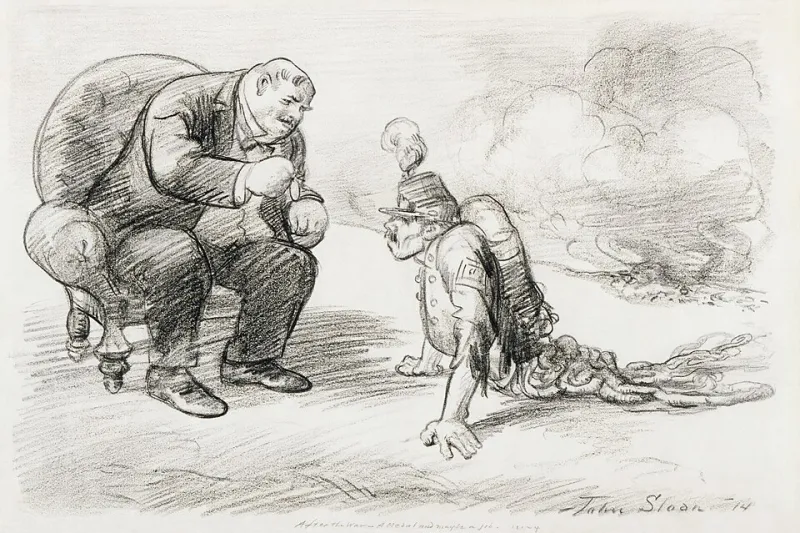
Photo: John Sloan, Public domain, via Wikimedia Commons
It's eleven at night and you're sitting in your kitchen recording an answer to a question you were given forty seconds to read. There's a countdown timer, a live webcam preview, and a prompt asking you to describe a time you handled conflict. You finish, hit submit, and hear nothing for two days. Then: we've decided not to progress your application on this occasion. No reason. No score. No name attached.
Automated hiring isn't a future-tense worry anymore. It's most of the funnel at a lot of large UK employers, and a surprising chunk of the mid-sized ones. So it's worth understanding what's actually happening in there — and what you can ask for.
The pipeline, roughly
Bulk hiring now runs through five or six stages, and most of them involve software making a judgement.
Parsing and ranking. Your CV and answers go into an applicant tracking system. Older systems did blunt keyword matching against the job description. Newer ones use language models to judge semantic closeness — effectively asking "does this read like the job advert?" That's a meaningful upgrade and a subtle trap, because it rewards people who mirror the advert's vocabulary.
Online assessments. Numerical reasoning, situational judgement, gamified tests measuring things like attention to detail or risk appetite. Some of this is genuinely validated psychometrics with decades of evidence behind it. Some of it is a quiz with a leaderboard.
Asynchronous video. You record answers to pre-set questions. Software transcribes the audio and scores the transcript for keyword coverage, structure, filler words, pace and sentiment. This is where most candidates feel the strangest, because the format is nothing like an actual conversation and the feedback loop is zero.
AI-assisted live interviews. Some employers use tools that transcribe, summarise and generate follow-up questions in real time. Here the AI is usually supporting a human rather than replacing one, though the summary is often what gets shared with the hiring panel — which means the summary is doing more work than anyone admits.
Proctoring. If the assessment is remotely invigilated, expect software watching for tab switching, eye movement and background noise. False positives are common and appeals are rare.
What's being scored, and what isn't
Here's the bit vendors are vague about: most of what gets measured is language. Vocabulary overlap, sentence structure, use of the STAR format, degree of hedging, positivity ratios. Voice analysis may add pace and pauses. Gamified exercises add reaction time and accuracy.
What almost none of it measures is context. A career break to care for a parent reads as a gap. A regional accent can drop transcription accuracy — speech recognition systems have long shown measurably higher error rates on some accents than others, which means the transcript the model scores isn't quite what you said. Dyslexia and autism can affect pacing, eye contact and structure in ways the model has no way to interpret. Non-linear careers, overseas experience and industry-switchers all get flattened by a system optimised on the historic hires of a company that has never hired many of them.
And that's the quiet risk at the centre of all this: if a model learns from past hiring decisions, it learns the patterns of who a firm used to hire. Nobody has to intend discrimination for a system to reproduce it.
What the law says
The Equality Act 2010 applies to job applicants, not just employees. Direct discrimination, indirect discrimination and the duty to make reasonable adjustments all bite on recruitment. Indirect discrimination is the sharpest tool here: if an assessment format puts people with a particular protected characteristic at a substantial disadvantage, the employer needs an objective justification — and "it's what the vendor's algorithm does" isn't one.
Section 60 of the Act restricts pre-employment health questions, with limited exceptions. If a video tool infers a disability from how you move or speak, that's a live problem rather than a hypothetical one.
On the data side, UK GDPR and the Data Protection Act 2018 give you real leverage:
- Transparency. Articles 13 and 14 require meaningful information about automated processing at the point data is collected — usually buried in a privacy notice, but the requirement is for it to be intelligible.
- Subject access. Article 15 lets you request your personal data, including scores and, in many cases, the logic involved. One month, free, and employers routinely misjudge the deadline.
- Automated decisions. Article 22 restricts decisions based solely on automated processing that produce legal or similarly significant effects. Shortlisting arguably qualifies. Where it applies, you have rights to human intervention, to express a view, and to contest the decision.
- Impact assessments. Article 35 requires a data protection impact assessment for high-risk processing. Recruitment screening is squarely in scope, and you can ask whether one exists.
Public bodies have an extra layer: the Algorithmic Transparency Recording Standard, which requires central government departments and wider public sector organisations to publish records of algorithmic tools they use in decisions affecting the public.
Five questions worth putting in writing
You don't need to be aggressive. One polite email to the recruiter is enough, and the response tells you a lot.
- Will a human being review my application before any rejection is issued?
- Is any automated tool scoring or ranking my CV, video or assessment — and what is it assessing?
- What alternative formats or adjustments are available if the assessment format disadvantages me?
- How long is my video or assessment data retained, and which third-party processors are involved?
- Can I receive my scores or a copy of the data held about me?
If you need adjustments, ask early and specifically: extra preparation time, questions in advance, a text-based alternative to video, an untimed version of the test, a live interview instead of asynchronous. Employers are obliged to consider reasonable adjustments — they are not obliged to grant whatever you ask for, but they must engage.
Spotting inflated claims
A lot of "AI recruitment" is a spreadsheet with a landing page. Here's how to tell.
Red flags: "bias-free" as a flat claim; an accuracy percentage with no baseline, sample size or published method; "proprietary algorithm" used as a reason not to explain anything; no mention of a DPIA or independent audit; case studies that only ever quote HR directors, never candidates.
Green flags: a published validation study you can actually read; an independent audit or impact assessment; a named human in the loop at a specific stage; clear retention periods; a genuine alternative route for candidates who can't or won't use the video format; and plain-English disclosure of what is and isn't measured.
If you think you've been scored out unfairly
Start with a subject access request — a short email asking for all personal data held about you in relation to the application, including any scores, rankings or assessment outputs. That's usually enough to find out whether a human ever looked.
If a data protection right has been breached, the Information Commissioner's Office takes complaints. If you believe you've been discriminated against, ACAS early conciliation is the route before an employment tribunal — and note the deadline, three months less one day from the act you're complaining about. It is brutally short. Don't sit on it while you stew.
The thing worth being annoyed about
It isn't that machines are judging you. It's that unaccountable systems are being dressed up as neutral arithmetic, and the burden of finding out how they work falls on the people with the least power in the transaction.
The candidates who cope best with all this are the ones who ask questions early, ask in writing, and keep a copy. Not because they're difficult — because in a process designed to be opaque, documentation is the only leverage you've got.